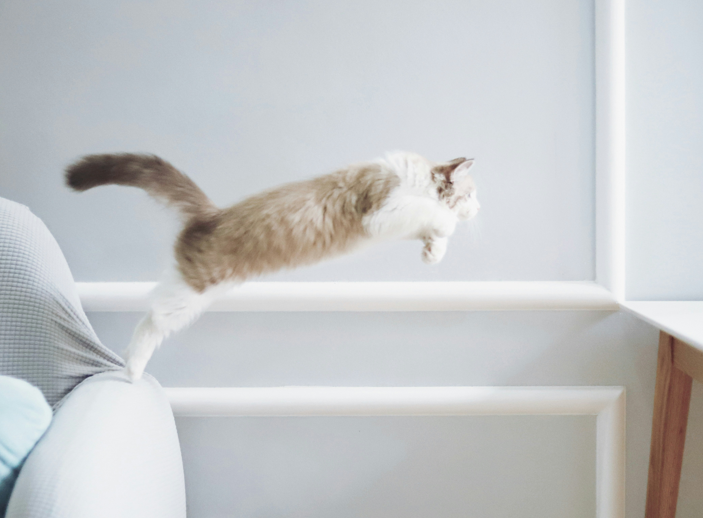
If you’ve ever watched your cat suddenly sprint across the living room at top speed, leap onto the couch, race down the hallway, and disappear around a corner, you’ve witnessed the famous cat zoomies. One moment, your feline friend is peacefully napping. The next, they’re acting like they’ve entered a high-speed championship.
But why do cats get the zoomies, and what exactly is going on in their furry little heads?
What Are Cat Zoomies?
The technical term for the zoomies is FRAPs which stands for ‘frenetic random activity periods.’ Despite the scientific-sounding name, there’s nothing particularly mysterious about them. Cat zoomies are short bursts of intense energy that can involve running, jumping, spinning, chasing imaginary objects, or racing from room to room and can last from a few seconds to several minutes.
For cats, these energetic episodes are completely normal. Even the laziest-looking house cat can suddenly transform into an Olympic sprinter.
Why Do Cats Get the Zoomies?
One of the biggest reasons why cats get the zoomies is simply to burn off energy. Cats are natural predators, and their wild ancestors needed bursts of speed to chase prey. Although your indoor cat may never need to hunt for dinner, those instincts haven’t disappeared.
Cats also spend a large portion of their day sleeping or resting. When they wake up, especially after a long nap, they may have a sudden surplus of energy. A quick sprint around the house can be their way of getting some exercise.
Another common trigger is the litter box. Many cat owners have noticed their pets racing around immediately after using it. There isn’t one proven explanation for this behavior. Some cats may simply feel relieved after going to the bathroom, while others may be responding to an instinctive desire to move away from the area.
Play can trigger zoomies, too. A feather toy, a noisy object, or even a mysterious speck of dust can suddenly activate your cat’s hunting instincts.
Why Do Zoomies Often Happen at Night?
If your cat chooses 2 a.m. for their nightly racetrack session, you’re not alone.
Cats are naturally most active around dawn and dusk, periods known as crepuscular hours. Their ancestors were adapted to hunting during these times, so your cat may still feel an instinctive urge to become active when the sun is rising or setting.
Indoor cats can also develop their own schedules. If your cat spends much of the day sleeping while you’re away, they may have plenty of energy stored up by the time you’re trying to sleep.
How Can You Manage the Zoomies?
In most cases, you don’t need to stop your cat from zooming. It’s healthy exercise and a normal part of feline behavior.
You can help your cat use that energy constructively by providing interactive toys, scratching posts, climbing structures, and regular play sessions. Wand toys are especially useful because they allow cats to stalk, chase, pounce, and “capture” their pretend prey.
If nighttime zoomies are keeping you awake, try scheduling an energetic play session in the evening, followed by a meal. This mimics cats’ natural sequence of hunting, eating, and resting.
Embrace the Chaos
Cat zoomies may seem completely random, but they’re actually a fun expression of your pet’s natural instincts and energy. Whether your cat races across the hallway at midnight or performs a dramatic lap around the furniture after breakfast, these moments are usually nothing to worry about.
So the next time your peaceful kitty suddenly turns into a furry blur, sit back and enjoy the show. The zoomies might be chaotic, but they’re also one of the many wonderfully weird things that make cats so entertaining.